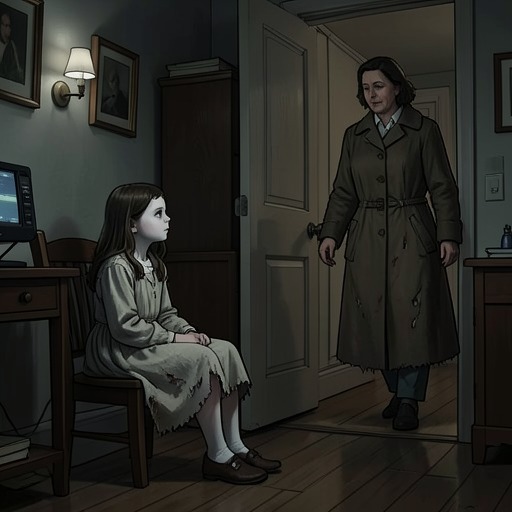
Stéphanie
Chanson douceStéphanie, Louise’s daughter, grows up in the shadow of her mother’s work: able to care expertly for infants, yet treated as an inconvenience in the homes and holidays that work brings them into. Her expulsion from a Paris school and Louise’s brutal beating of her mark the most explicit rupture in their relationship; her later disappearance from home completes a history of exclusion that helps explain the distance at the center of Louise’s life.
Identity and Childhood
At eight, Stéphanie could change a diaper, prepare a bottle, lift a newborn with a steady hand beneath its neck, bathe an infant, and remember the basic rule of laying babies on their backs and never shaking them. Adults praised her unusual maternal instinct and devotion. The praise, however, grew out of a childhood shaped by labor: Louise cared for other people’s babies at home, and Stéphanie learned the routines of infant care while growing up among them.
The babies’ mothers left expressed milk in labeled containers in the refrigerator. One night Stéphanie drank the milk set aside for Jules, a red-faced infant whose sharp nails had scratched her cheek. She never forgot its sour, spoiled-melon taste, which seemed to remain in her mouth for days. The memory makes the household’s intimate arrangement concrete: other women’s babies, their food and care, and Stéphanie’s own childhood all occupied the same domestic space.
Growing Up in Other People’s Homes
For several years, Louise worked for the Rouvier family and took Stéphanie with her to their country house. Louise was working; Stéphanie was nominally on holiday, but she was not free to enjoy it like the family’s children. Louise instructed her to keep quiet and not appear to be enjoying herself too much, warning that the hosts might resent it. At meals, mother and daughter sat apart from the hosts and their guests, lowering their eyes and eating in silence.
The Rouviers were uncomfortable with Stéphanie’s presence. They found reasons to send her on errands or tell her that her mother needed her in the kitchen, and Louise forbade her from going near the swimming pool. On the eve of their departure, Stéphanie performed impressive flips and somersaults on the boys’ new trampoline, drawing cheers from the other children. Mme Rouvier then asked her to get down so the younger boys could use it. She privately told her husband that Stéphanie should perhaps not be invited back, ostensibly because seeing what she could not have might hurt her. His relieved smile reveals the social arrangement more plainly: the child was present through her mother’s employment, but never fully admitted as a guest.
At home, Stéphanie sometimes searched through drawers, boxes and photo albums while Louise put the employers’ homes in order. She urged her mother to stop washing dishes and sit with her. Louise, by contrast, enjoyed the parents’ pleased discovery that they had received a cleaner as well as a babysitter. The difference between mother and daughter’s responses shows how domestic work could become both Louise’s means of belonging and the reason Stéphanie remained peripheral.
School, Expulsion, and Violence
When Stéphanie entered middle school, Mme Perrin offered to place her in a better-rated Paris school than the one she would have attended in Bobigny. The opportunity quickly became a source of conflict. Within weeks of starting the equivalent of ninth grade, Stéphanie was disrupting lessons, throwing objects, answering teachers with obscenities, skipping school and smoking marijuana before noon in a square. She hid warning notes and summonses from Louise.
Mme Perrin summoned Louise, explaining that Stéphanie would face a disciplinary hearing and that her mother would have to defend her. In the hearing room, teachers and parent representatives described Stéphanie as disruptive, undisciplined and insolent. They also questioned why Louise had failed to answer their calls and messages or respond to teachers’ requests for meetings. Louise pleaded for another chance, describing her own principles and experience in raising children. When asked about those children, she explained that she meant the children she cared for every day, and insisted that her employer was satisfied with her work. Her defense exposes how readily her professional competence with other people’s children could stand in for an account of her relationship with her own.
Outside the room, Stéphanie laughed and joked with classmates, apparently more bored than frightened by the proceedings. Louise, waiting beside her, experienced the contrast as humiliation and effort wasted. The school ruled that it could not manage Stéphanie and that she would be better placed in a neighborhood nearer home. In March, after a winter that seemed unwilling to end, Louise understood that her daughter had been expelled.
On the bus home, Louise remained silent while Stéphanie watched the window with headphones in. Near the market, Louise seized her by the sleeve and dragged her along with startling force. Once they had entered the gate at Jacques’s house, she beat Stéphanie: punching her back until she fell, slapping and clawing her face, pulling her hair and continuing as the girl curled up and cried. When Stéphanie stopped moving, Louise spat at her. Jacques heard the commotion and watched from a window without intervening. The school’s disciplinary decision thus becomes a domestic assault, witnessed but not stopped by the other adult in the home.
Leaving Home
Stéphanie’s departure is described as the end of a long effort to become unobtrusive. She had felt that her presence disturbed Jacques and that her laughter might wake the babies Louise cared for. She imagined her body pressed against the narrow hallway wall so others could pass, and worried about blocking a passage or taking a chair someone else might want. She felt that she spoke badly and that even an innocent laugh could offend. In time, she developed an ability to be invisible; her disappearance is presented as an extension of that learned retreat.
Before leaving for good, she began spending Friday nights out with neighborhood teenagers, returning in the morning pale, red-eyed and hungry. She ate standing at the refrigerator, digging into the food Louise had prepared for Jacques’s lunches. Once she dyed her hair red and pierced her nose; then she began vanishing for entire weekends. One day she did not return to the house in Bobigny. She had already left school, and, in the narration’s stark phrasing, nothing remained to hold her there—not the lycée, nor Louise.
Louise reported her missing, but when told that running away was common at her age and that she might come back, she did not pursue the matter. Neighbors later said Stéphanie was in the South, in love and moving around. Louise did not ask for details or press them to repeat what little they knew. Her daughter’s departure is therefore not followed by a reconciliation or a clear account of her later life. The narrative emphasizes instead Louise’s failure to seek her out, a silence that stands in sharp contrast to the energy she devotes to the children in her care.
Narrative Significance
Stéphanie’s childhood parallels the household arrangements that later make Louise indispensable to Myriam and Paul. Louise’s care allows employers to work and sustains the appearance of a well-run family home; her daughter, meanwhile, is expected to remain quiet, grateful and out of the way. In the Rouvier household, even a holiday places Stéphanie below the employers’ children, while the school hearing shows Louise’s fluency in childcare does not protect her from judgment as a mother.
The contrast also complicates the idealized image of Louise as a naturally devoted caregiver. She can be attentive and skilled with infants, and she can meticulously organize the lives of the Massé children, yet she is violent toward Stéphanie and ultimately does not look for her after she disappears. Stéphanie’s story does not explain away Louise’s later actions; it supplies a distinct history of abandonment and failed care within the very life that makes Louise appear indispensable to another family.